











Georgia Legal Guide: Identifying TMJ Injury Symptoms After a Car Accident and Protecting Your Claim


Key Points:
- Car accidents can cause TMJ injuries due to whiplash, airbag deployment, steering-wheel impact, and sudden force to the head and neck.
- TMJ symptoms are often delayed, and insurers will try to use this as an excuse to deny your claim.
- TMJ injuries can be permanent and expensive, requiring everything from surgery to injections.
- You generally have two years to file a TMJ related claim in Georgia, but strong medical evidence and consistent treatment are critical to maximizing what your claim is worth.
You come to a sudden stop in bumper-to-bumper traffic on I-285 and another driver slams into the rear of your vehicle, causing minor soreness in your neck and shoulders. Although you feel fine to begin with, things worsen over the next week. You start waking up with headaches and have a constant dull ache near your ears. You can’t even eat without your jaw clicking and popping when you chew.
You finally head to your doctor to get treatment, and they share something unexpected: your “simple” accident may have caused a TMJ injury. This requires medical appointments and following through on specialist treatments, and you now have a growing pile of questions about whether insurance should cover this or whether you can file an injury claim.
Do Car Accidents Cause TMJ Injuries?
The temporomandibular joint (TMJ) is the hinge of your face that connects your lower jaw to your skull in front of each ear.
A car accident TMJ injury (sometimes called a TMJ disorder or TMD) occurs when you receive direct damage to the joint or related damage to the muscles, ligaments, and cushioning disc around it. When you get in a car crash, your jaw ligaments can stretch, the disc in your jaw can shift or tear, your jaw muscles might get inflamed, or you might fracture or dislocate your jaw. When speaking about car accidents, the lower part of a driver’s or front-seat passenger’s face will instantly hit the exploding front or side airbag, and that explosive airbag has the ability to hit the jaw so hard that it dislocates the alignment of the jaw.
What if My TMJ Symptoms Were Delayed After the Car Accident?
For TMJ injuries its common to not notice that you have TMJ until days after. Its an injury that gets progressively worse as time goes on. Car crashes result in a flood of adrenaline that can mask pain, causing TMJ symptoms days or weeks later when inflammation builds. Thus, TMJ injuries are frequently overlooked.
What Types of Car Accidents Are Known to Cause TMJ Injuries
Your jaw can be easily injured due to sudden changes in force that occur during car accidents, including:
- Rear-end collisions transfer force into the jaw joint.
- TMJ injuries and whiplash go hand-in-hand due to hyperextension of muscles shared between your neck and jaw.
- Airbags can strike the face and jaw with significant force.
- Hitting your steering wheel or dashboard can drive your jaw into the joint.
- Facial trauma, such as hitting the window or headrest, can injure the joint directly.
Your vehicle doesn’t need to be severely damaged to cause TMJ injuries
Insurance companies love to argue that minor damage equals minor injury, but your body and your car body respond to accidents differently. Small fender benders can still cause rapid head-and-neck motions that injure your jaw joint.
How and Why to Get a TMJ Injury Diagnosis After a Car Accident
A diagnosis is evidence that you were injured from the accident. The actual medical record or report declaring your TMJ injury will be used to prove that the car accident resulted in a jaw injury. Make sure you seek out an early diagnosis from your provider, ranging from medical and dental evaluations looking for jaw problems early on to physical examinations where your provider checks for signs like clicking, tenderness, or jaw misalignment. They might even measure your jaw opening!
Confirming and Proving a TMJ injury With Scans
Objective imaging like CT and MRI scans carries far more weight with insurers than self-reported pain. CT scans are useful for detecting fractures and joint changes while MRI scans show whether the jaw disc has been dislocated or damaged. X-rays can reveal fractures or obvious bone problems.
Which Specialists Treat TMJ injuries for Car Accident Victims
Depending on the severity of your injuries, you might need to see an oral and maxillofacial surgeon, a TMJ specialist or dentist, an ENT (ear, nose, and throat) doctor, a neurologist (for headaches), or a physical therapist.
How an Early diagnosis Can Prevent Legal Issues
Seek an early diagnosis to link your injury to the crash and get you treatment before the problem worsens. If you delay diagnosis, your insurer might argue your TMJ injuries ccame from something else.
TMJ Symptoms to Watch for After a Car Accident
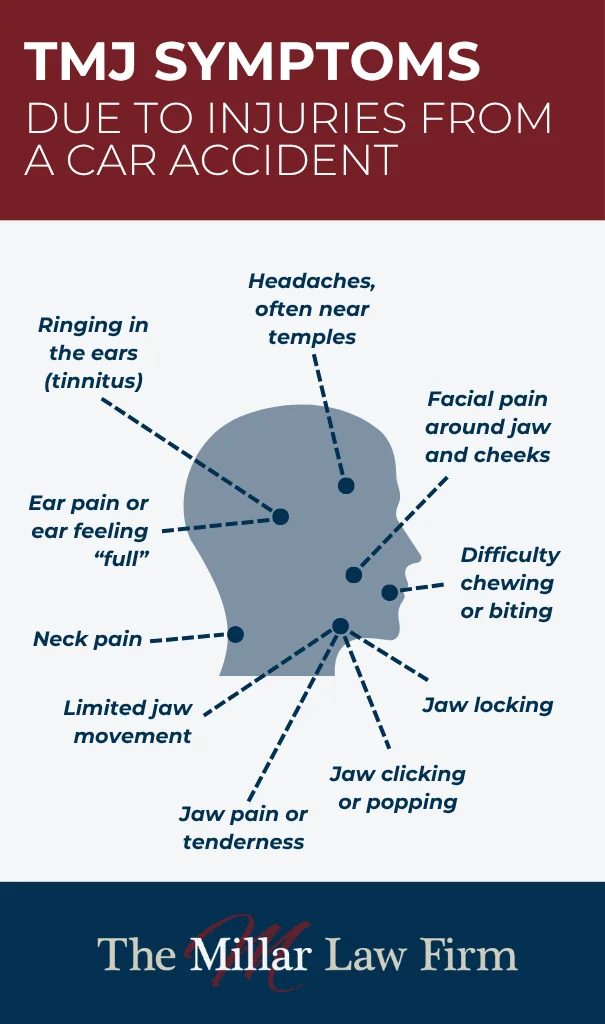
Long-term effects of a more serious TMJ injury include chronic pain, difficulty eating, and sleep disturbances. Severe damage to the jaw may require ongoing treatment as well. Luckily, Georgia law allows recovery for permanent impairments and projected future costs.
How TMJ Injuries are Treated After a Car Accident
Doctors will usually pursue more conservative treatments like medications, physical therapy, jaw exercises, and oral appliances and mouth guards and will escalate only if needed.
Depending on how severe your injury is, your doctor might recommend advanced treatments, including injections of corticosteroids, arthrocentesis (a minimally invasive procedure to flush out the joint), surgery, and sometimes joint replacement.
Recovery timelines, future needs, and long-term costs
If you have mild TMJ damage, your jaw may improve in weeks. But more serious injuries may take months to improve, while chronic cases could require care for multiple years or up to your entire lifetime. In these advanced cases, you may need mouth guards, repeat injections, follow-up imaging, and frequent specialist visits.
Always get the full picture of your treatment to determine how much your injury will cost you in the long term. Until then, don’t settle your claim with your insurance company.
TMJ Injuries and Teeth
Your jaw joint and teeth work together, meaning a TMJ injury can lead to bite misalignment, teeth grinding, or cracked or broken teeth due to grinding or an altered bite. In severe cases, you may even lose some of your teeth. You might also need dental implants to replace or repair damaged teeth and other dental treatments to manage the ongoing effects on your bite.
Georgia law allows you can seek compensation for future dental expenses due to a TMJ injury.
Implications of Pre-Accident TMJ Problems
Even if you have mild TMJ issues (like jaw clicking) before your auto accident, your claim is not doomed.
Georgia follows the “eggshell plaintiff” rule: the negligent driver “takes you as they find you,” meaning the at-fault driver cannot escape responsibility just because you were more fragile or more vulnerable than the average person. If the crash aggravated or worsened your pre-existing TMJ condition, the at-fault driver is responsible.
Seek diagnosis from your doctor
Medical providers will compare prior records and symptom history to new imaging findings and the change in your function and pain. Based on this analysis, a doctor can provide a powerful written opinion that a crash “more likely than not” aggravated your condition.
Why Auto Insurance Arguments Fail When it Comes to TMJ Injuries
Insurers will try to claim your TMJ problem was “pre-existing” or a result of “degenerative wear-and-tear.” But Georgia law does not require you to have been perfectly healthy. This means that honest disclosure of your prior history will help you build your credibility.
Proving Your TMJ Injury was Caused by an Auto Accident
Determining causation of your TMJ symptoms can be an obstacle between you and the recovery you deserve. From medical and dental records to documentation of symptoms, gathering this evidence to prove your TMJ injury was caused by the auto accident you were in can help your case:
- Medical records that document your symptoms, diagnosis, and treatment
- Diagnostic imaging, such as CT and MRI scans, showing objective damage
- Dental records including everything from bite changes and grinding to joint dysfunction
- Medical Specialist opinions/testimony from oral surgeons or dentists
- Treatment timelines tying your symptoms to your crash
- Document symptoms with a daily journal noting pain levels, occurrences of jaw locking, headaches, and missed activities
- Expert testimony establishing that the crash “more likely than not” caused or aggravated your injury
The Importance of Prompt Treatment
Making sure you seek out treatment right away is the best way to tie your injury to the crash. By getting your jaw complaints in the medical record, it becomes harder for your insurer to blame “something else,” like gaps in treatment, and deny your coverage.
How Car Accident Attorneys Establish Causation for a TMJ Injury
Experienced attorneys gather your medical records, obtain expert testimonials from medical professionals, and — when needed — send a spoliation (preservation) letter to preserve dash-cam, surveillance, and vehicle “black box” (event data recorder) information before it is erased.
Expected Recovery from TMJ Injuries
Your recovery is limited by how the facts of your case comport to Georgia’s two categories of recoverable damages.
You can pursue economic damages resulting from medical and dental expenses, projected medical treatments, lost wages, and reduced/lost earning capacity.
You can also recover non-economic damages such as pain and suffering, loss of enjoyment of life, permanent impairment (loss of jaw function), and expected future damages.
- The severity of your symptoms and how much they limit daily life
- Whether you need surgery or advanced procedures
- How permanent your injuries are, supported by a doctor’s impairment rating
- The impact on your daily life, such as being unable to eat, sleep, or speak normally
- The impact on employment due to missed work or reduced ability to do your job
Georgia also has insurance policy limits that will affect your settlement. Minimum liability is just $25,000, so you will likely need to pursue UM/UIM coverage for serious injuries if the at-fault drivers available insurance coverage is the states minimum liability requirements.
Navigating Your TMJ Injury Claim with Auto Insurance Companies
Insurers will try to dispute your TMJ injury claims by using specific tactics like claiming your TMJ damage was pre-existing. Attorneys can help you navigate how to best respond to your insurance companies attempts to undercut your recovery.
[INSERT MICROGRAPHIC HERE: https://canva.link/yaauvpvlctnerru ]
Example TMJ Injury Settlement Scenario
The following is a hypothetical example for illustration only.
Maria, a 38-year-old teacher, is stopped at a red light in Hapeville when another driver rear-ends her, leaving moderate damage to her bumper. She feels only light neck stiffness at the scene and doesn’t think much of it at the time. Over the next two weeks, though, she develops headaches and a persistent ache near her right ear. Her jaw begins clicking, and chewing turns painful. She calls her dentist, who refers her to an oral and maxillofacial surgeon. An MRI reveals a displaced disc in her right temporomandibular joint, and the surgeon diagnoses a post-traumatic TMJ disorder. Maria starts with conservative care — anti-inflammatories, a custom oral splint, and physical therapy — but when her pain persists, her surgeon performs an arthrocentesis and advises that she may need additional treatment down the road.
When Maria files her claim, the at-fault driver’s insurance adjuster pushes back hard. The adjuster argues that her TMJ problems were “pre-existing” and that the crash was “too minor” to have caused them, pointing to the modest vehicle damage and the ten-day gap before Maria first reported jaw symptoms. Maria’s attorney dismantles both arguments with evidence rather than assertion: the MRI showing objective disc displacement, her treating surgeon’s written opinion that the collision “more likely than not” caused the injury, dental records establishing no history of TMJ complaints before the crash, and a projection of her future care costs reduced to present value.
Faced with consistent treatment records and a clear causation opinion from a treating specialist, the insurer abandons its low offer and the claim resolves for Maria’s past medical and dental bills, her projected future treatment, lost wages, and pain and suffering.
Yes, whiplash and TMJ injuries share the same cause (sudden, forceful head-and-neck motion) and can happen together.
Yes. Rear-end collisions are one of the most common causes of crash-related TMJ injuries. Even if your face never strikes anything inside the car, the sudden jolt to your body can cause damage to your jaw!
Yes. It can be injured even when your vehicle has little visible damage because it is a fairly delicate joint.
Yes. While many TMJ injuries heal with treatment, some become chronic or permanent.
Yes. Headaches — often near the temples — are one of the most common TMJ symptoms. These are often paired with ear pain and ringing in the ears.
Yes. TMJ injuries can cause bite misalignment, grinding, cracked or broken teeth, and sometimes tooth loss.
Doctors will usually suggest medication, therapy, and oral appliances for moderate TMJ damage. In severe or persistent cases, you may need surgery, arthrocentesis, or injections.
It varies. Mild strains may resolve in weeks, while serious injuries can last months. Chronic cases may require years of ongoing care.
You can still recover under Georgia’s eggshell plaintiff rule: the at-fault driver is responsible for aggravating or worsening a pre-existing condition.
Car crashes cause your adrenaline to spike, which can mask your pain. Once inflammation builds, you will start experiencing more symptoms. Always report symptoms to your medical provider as soon as they occur.
There is no flat figure, and the value depends on severity, permanency, the need for surgery, the impact on your life and work, future costs, and available insurance coverage.


