










Georgia Legal Guide: Can Lost Work Income Be Included in a Georgia Dog Bite Settlement?


Key Points:
- Lost wages in dog bite claims are considered special damages, and many dog bite victims have recovered thousands of dollars in lost income in Georgia courts.
- Proving that you lost hourly or salaried wages is fairly straightforward, but showing that you lost commissions, PTO, benefits, or even your job will require more documentation.
- Without the proper evidence that shows your fee- or commission-based earnings, Georgia courts will likely dismiss your claim entirely.
- Reach out to an experienced personal injury attorney to ensure you gather the needed records to ensure every dollar of lost income is included in your settlement or verdict. You do not have to prove your case alone.
After being bitten or attacked by a dog, you are likely trying to balance everything from pain and large medical bills to shrinking paychecks and evaporating PTO. This might even be causing you severe anxiety over potentially losing your job. Or maybe you work for commissions and lose a client or a contract because you could not show up.
Know this: Georgia law protects you when you are the victim of an aggressive dog. Any money you lose from missed work is a real, compensable loss and can be included in your dog bite settlement or court judgment.
While some lost income claims are easier to prove, others require a lot of documents, testimony from experts, and a clear strategy from an experienced lawyer. This legal guide explains the different types of lost work income you may be entitled to and what you need to know to protect your right to get paid back for every dollar you’ve lost.
Table of Contents
What Georgia Laws Cover Lost Income from Dog Bites?
You need to know about two key laws that are in your corner after being injured by a dog:
The Dangerous Animal Statute (O.C.G.A. § 51-2-7)
This statute holds dog owners accountable for your injuries and lost income if:
- The dog had a history of aggressive behavior,
- The owner knew about that dangerous tendency, and
- The owner was careless in managing the dog.
Even further, there are many local ordinances that require dogs to be leashed. In these localities, if the dog that bit you was loose at the time of the attack, you will still need to prove the owner knew their dog was dangerous.
The General Damages Statute (O.C.G.A. § 51-12-2)
When you are injured due to another person's negligence, you are entitled to recover "the full value of the life" as affected by the injury. This statute provides extensive coverage from special damages like medical bills and lost wages to general damages like pain and suffering. If you can show that the dog owner was liable for your injuries with proper evidence, they are then responsible for all your reasonable losses, including lost wages.
What Types of Lost Work Income Can Be Included in a Dog Bite Claim?
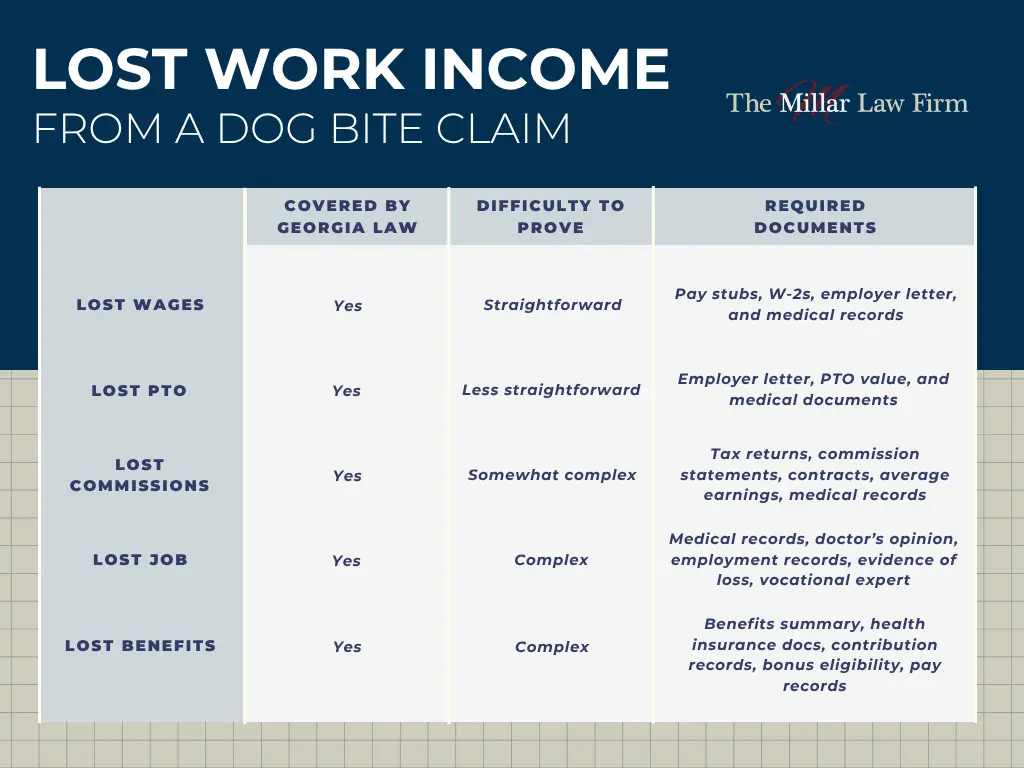
Explore these work-related losses and how Georgia courts have treated each one to learn how they may form a part of your claim.
Lost Hourly or Salaried Wages
If you earn a regular hourly or salaried paycheck and had to miss work due to your dog bite injuries, this is the most straightforward type of lost income to recover. But these documents will help you prove your claim:
- Pay stubs and W-2s,
- A letter from your employer explaining the dates you missed and your rate of pay, and
- Medical records showing why you couldn't work.
Lost Paid Time Off (PTO)
You worked hard to earn your PTO. If you were forced to use it because of a dog bite injury, you can typically recover the lost value under Georgia law. Without the dog owner’s negligence, you would not have been attacked, and you still would have those PTO days to use for a vacation, a family event, or a personal day.
Under the "collateral source rule" in Georgia, a defendant generally can't reduce what they owe you just because you received benefits from your employer's PTO policy. To make sure you can recover your lost PTO, you’ll need some relevant documents:
- A letter from your employer or HR department confirming how many PTO hours or days you used because of your injury,
- The monetary value of your PTO hours lost, and
- Medical documentation showing why you needed time off.
Lost Commissions
If you're a freelancer, independent contractor, salesperson, gig worker, or anyone who earns variable income, you can only recover lost income with precise documentation of your past earnings. You’ll need more proof that you lost fees, tips, or commissions from your dog bite injuries, including:
- Tax returns for at least 2-3 years,
- Commission statements, 1099 forms, or invoices,
- Contracts showing expected income from clients or projects,
- A clear calculation of your average monthly or weekly earnings, and
- Evidence connecting your missed income to the dog bite injury.
Lost wages must be pleaded “with particularity and proven without speculation or uncertainty,” meaning you need proof of past earnings for lost fees or commissions in order to even have a jury consider the case (Hill v. Jones).
Lost Job Due to Medical Complications
Trying to prove you lost your job because of a dog bite is far more complex than the examples above, requiring far more evidence:
- Medical records showing the severity and permanence of your injuries,
- A doctor's opinion that your physical limitations prevent you from performing your job,
- Employment records showing the type of work you did before the attack,
- Evidence of your job loss or demotion directly tied to your injuries, and
- A vocational expert who can testify about your reduced earning potential, if needed.
This means you need medical evidence (and often expert testimony!) to establish that your injuries keep you from performing your job duties, and that this limitation isn’t temporary.
Lost Benefits
Following a dog bite injury, it is really common to not only lose your income or PTO but also other benefits from your job such as health insurance, retirement contributions, bonuses (tied to performance or attendance), or even overtime opportunities!
Any lost benefits are considered special damages, which can be recovered with a lot of careful documentation (O.C.G.A. § 51-12-2). You need to show that you lost benefits and give evidence for the dollar value of what you would have received if not for the injury, including:
- A benefits summary from your employer,
- Documentation of any health insurance lapse or out-of-pocket costs,
- Records of employer retirement contributions,
- Proof of bonus eligibility and a calculation of what you would have earned, and
- Pay records showing patterns of overtime history.

 1201 West Peachtree Street #2339 Atlanta, GA 30309+1-770-212-3795$0-$100000
These are great representatives who make up a great firm and contribute to an excellent customer experience. Keep up the high-quality work!

How a Lost Income Claim Might Play Out in the Atlanta Metro Area
David got a request from a Fayette County homeowner requesting to fix her broken air conditioner. When the 41-year-old HVAC technician arrives, the homeowner invites him to the backyard. A neighbor's loose dog charges at him and bites his hand and forearm. He also falls backward, twisting his knee.
David goes to the emergency room for stitches, a rabies shot, and a knee brace. He loses the ability to perform key functions of his job, which results in over ten thousand dollars in lost wages:
- $7,200 in missed wages (6 weeks at $1,200/week),
- $1,200 in PTO used during the first week of recovery,
- $2,400 in lost overtime he typically worked during summer,
- $360 employer 401(k) match lost during time off, and
- $500 lost bonus for quarterly performance (attendance-based).
Total estimated lost work income: $11,660 (in addition to medical bills, pain and suffering, and potentially punitive damages).
If David can show the neighbor knew the dog had a tendency to escape and had snapped at someone before, the neighbor can be held liable for all of David's reasonable losses, including every dollar of lost income (O.C.G.A. § 51-2-7).
Three Georgia Dog Bite Cases Where Victims Won Compensation That Included Lost Income
1. McCreary v. Andrews (Fulton County, 2021)
A dog jumped a fence and attacked Christopher McCreary. The court awarded McCreary $36,000 in lost income, plus $1,740.63 in medical bills, $75,000 for pain and suffering, $75,000 in punitive damages, and $75,194.25 in attorney's fees, totaling $263,179.88.
2. Praylo v. Deloach (Chatham County, 2019)
Sherlisa Praylo was bitten without provocation by a dog that had attacked others before. She submitted her W-2s as evidence to recoup over two and a half months of lost income, so the court awarded her $2,551.83 in lost wages, $12,000 for pain and suffering, and $18,000 in punitive damages, for a total judgment of $35,990.44.
3. Givan v. Bass (Fulton County, 2022)
A dog charged [First name?] Givan, giving him a broken hand, wrist, femur, and hip. The court awarded $242,821.72 in medical bills and costs and $2,000,000.00 in compensatory damages for ongoing pain, disabilities, and impairment.
Myths and Facts About Recovering Lost Income from a Dog Attack
Myth: "I can't claim lost income if I use my PTO during my recovery."
Fact: If you have to use your PTO due to someone else’s actions, you can recover this under Georgia’s collateral source rule. Never forget that your PTO is an earned benefit with real monetary value.
Myth: "I can only recoup lost income for the exact days I missed work."
Fact: It is possible to recover more than just your lost income in Georgia, including lost overtime, lost bonuses, lost employer benefits, and lost earning capacity (O.C.G.A. § 51-12-2).
Myth: "I can only make a lost wage claim if the dog bites me.”
Fact: You can still receive damages when your injuries are caused by a dog’s aggressive behavior (Givan v. Bass and Green v. Wilson).
Myth: "If the dog owner doesn't have insurance, I won’t be able to recover any of my lost wages."
Fact: The owner of the dog that attacked you is personally liable for damages regardless of their insurance status (O.C.G.A. § 51-2-7). They must pay for dog bite claims whether or not they have insurance that covers it, and punitive damages may be awarded on top of lost income in cases of especially reckless conduct (Praylo v. Deloach and McCreary v. Andrews).
Myth: "I don't need actual records to estimate my lost income."
Fact: You need detailed records of your lost income to prove your case. Georgia courts require lost wages to be pleaded "with particularity and proven without speculation or uncertainty" (O.C.G.A. §§ 9-11-9(g) and 51-12-2).
What Steps Should You Take Right Now to Protect Your Lost Income Claim?
If you've been bitten by someone else's dog in Georgia and are missing work, take these steps immediately:
- Keep your pay stubs, W-2s, 1099s, and any commission statements on hand.
- Request an official letter from your boss that includes everything from your dates of absence and rate of pay to any PTO you used and benefits you lost during your time off.
- Ask your doctor to write down your work restrictions, including both that you were unable to work and for how long.
- Track your PTO use and record lost overtime and bonuses as they happen.
- If you are self-employed or earning commissions, gather up your tax returns and earning records.
- Do some cursory research to find out whether your city has a leash law or containment ordinance.
- Talk to a personal injury attorney who handles dog bite cases to help you calculate the full value of your lost income, gather evidence, and fight for compensation.
Remember, you didn't ask to be attacked. You shouldn't have to absorb the financial hit.
Yes, you can recover compensation for income lost during the time you were unable to work, even if you returned to your job.
Georgia courts calculate lost wages based on documented evidence of earnings and time missed. You're entitled to the full value of life affected by the injury (O.C.G.A. § 51-12-2). They examine pay stubs, W-2s, tax returns, employer letters, and similar records to determine the dollar amount.
Yes. If you are an independent contractor, freelancer, or gig worker, you can recover lost income under Georgia law. You must provide proof of past average earnings through tax returns, 1099 forms, invoices, and contracts (Hill v. Jones).
Yes. A claim can be pursued for any injury from an aggressive dog that results in lost income.
This is a devastating result with little recourse. Special damages like lost wages must be pleaded with particularity, which is why documenting earnings and losses from day one is critical (O.C.G.A. § 9-11-9(g)).
Be prepared for the dog owner’s insurance company to deny your claim. They will often argue your injuries didn't justify the time you took off work. In order to recover the money you lost, make sure you have clear medical documentation from your doctor explaining your physical restrictions and how long you can’t work.
Yes. As long as you get documents that connect your emotional injuries to a dog attack, you can and should add them to your lost income claim.
There is no cap on lost income recovery in personal injury cases. To maximize your recovery, you will need credible evidence explaining the full extent of your losses.


