





How Car Accident Claims Work for County Animal Control Officers


Key Points:
- County animal control officers can pursue both workers’ compensation and personal injury claims against at-fault drivers (O.C.G.A. § 34-9-11.1).
- When your animal control vehicle has the emergency lights on, the Move Over Law shields you from proving the at-fault driver’s negligence (O.C.G.A. § 40-6-16)
- County workers may be able to maximize compensation after a car accident by recovering compensation from the at-fault driver’s insurance company and from a county’s UM/UIM motorist policy, if the county has an applicable UM policy.
- Workers’ comp liens cannot affect your ability to make claims with your insurance. The “Made Whole” doctrine protects your settlement (O.C.G.A. § 34-9-11.1(b)).
Animal Control Officers Take Risks With Vehicles – Not Just Stray Pets
As a county animal control officer, you already know that working around animals can be dangerous. What you may not expect is how much of a risk other drivers can pose while you are doing your job — whether you are driving to a call, transporting an animal, or working on the side of the road.
In many Georgia counties, animal control officers spend a large portion of the workday driving or working near traffic, which increases the chances of being involved in a serious car accident while on the job. When you are injured in a crash involving a county vehicle it can also create complicated legal and insurance questions. You may wonder how a car accident claim works for an animal control officer, whether workers’ compensation affects your right to recover compensation from the at-fault driver, or whether the insurance company will try to avoid paying for your injuries because you are a county employee. This guide answers those questions and more.
Hit While Handling an Animal on the Side of the Road? How it Works if an Animal Control Officer Was Hit as a Pedestrian
Animal control work often requires you to stand on or near Georgia roads while handling animals. If you were hit as a pedestrian while working, the type of legal claim you may have will depend on whether the driver who hit you was at fault.
If you were responsible for the accident (which is rare but possible) and the driver is not considered legally liable for your injuries, workers’ compensation may still cover your medical treatment and a portion of your lost wages.
If you were not at fault, you may also be able to file a legal claim against the at-fault driver. This can allow you to recover compensation for pain and suffering, lost income, and medical expenses — even if workers’ compensation is already paying for some of your medical care and missed income.
These are two separate claims that can run side by side. Workers’ compensation helps provide faster access to medical treatment and partial wage benefits, while a personal injury claim may help recover damages that workers’ compensation does not cover, such as pain and suffering and additional lost income.
One important thing to understand is that if you were injured while working for the county, there is usually some form of coverage available for your pedestrian accident — whether through workers’ compensation, a claim against the at-fault driver, or both.
Who Is Responsible for Your Injuries If You Were Hit While Responding to an Animal Call?
Pedestrian Accidents
If you were hit by a vehicle while working as a county employee on or near a roadway, the at-fault driver may be legally responsible for your injuries. In some unique situations, the driver may argue they were not liable — such as if you unexpectedly ran into traffic while chasing an animal or if severe weather conditions made visibility extremely poor and prevented the driver from stopping in time. However, those situations are less common because most animal control officers are trained to use caution while working near roads and traffic.
Drivers in Georgia owe a duty of ordinary care and have an increased responsibility to watch for pedestrians (O.C.G.A. § 51-1-2 and O.C.G.A. § 40-6-93). A driver who was speeding, texting in violation of Georgia’s Hands-Free Law (O.C.G.A. § 40-6-241), following too closely (O.C.G.A. § 40-6-49), or simply claiming they “didn’t see you” may have breached that duty of care. If your patrol vehicle’s emergency lights were activated and you were working near the vehicle, there is a strong likelihood the driver could be held liable for your injuries, meaning you may have a valid personal injury claim.
Car Accident
If you were traveling in an animal control vehicle and were involved in a motor vehicle accident, the type of legal claim available will depend on who was negligent. Potential scenarios include:
- You were driving the county vehicle and made a driving mistake:
In this situation, you would generally only qualify for a workers’ compensation claim. - The county animal control driver caused the accident: If you were a passenger in the county animal control vehicle and the county driver made a negligent driving decision that caused the crash, you may qualify for both a workers’ compensation claim and a car accident claim against the county vehicle’s insurance coverage.
- Another driver caused the accident: If another driver made a negligent driving decision that caused the collision, then — like most Georgia car accident cases — that driver may be held liable. You may have a personal injury claim against the at-fault driver in addition to your workers’ compensation claim.
How Emergency Lights Affect Liability in Animal Control Vehicle Accidents
One of the most unique aspects of motor vehicle accidents involving animal control vehicles is the use of emergency lights. Because these vehicles are not police cars, fire trucks, or ambulances, some drivers may not take the emergency lights on an animal control vehicle as seriously. However, if your emergency lights were activated at the time of the accident, it is important to understand that Georgia law provides protections for authorized emergency and county vehicles operating with activated emergency lights and sirens under Georgia law, O.C.G.A. § 40-6-6. County animal control vehicles can fall under these protections in certain situations.
What this often means is that it can increase the likelihood of the other driver being found liable for the crash, even in situations where they argue they were otherwise obeying normal traffic laws while the animal control vehicle was responding to a situation.
Which Insurance Policies Can You Use to Recover Compensation After the Crash?
Insurance companies won’t reveal this information to you because it isn’t in their best interests. Consider contacting a lawyer to hunt down each layer of insurance policy you can tap. In general, the that may apply can include:
- At-fault driver’s personal policy liability
- At-fault driver’s employer’s commercial policy
- MedPay on applicable vehicle policies
- County fleet UM/UIM (you were “occupying” or working with the county truck)
- Workers’ compensation
- Umbrella policies (commercial or personal, if the terms allow for it to be applied to work vehicles)
Can You File a Personal Injury Claim If You Were Hit While Working for the County?
Yes. Working for the county doesn’t block you from suing the driver. You have a right to bring a third-party claim against anyone other than your employer (O.C.G.A. § 34-9-11.1).
A third-party claim recovers everything from pain and suffering and lost overtime to future lost earning capacity and loss of enjoyment of life.
Can You Have Both a Workers’ Compensation Claim and a Personal Injury Case?
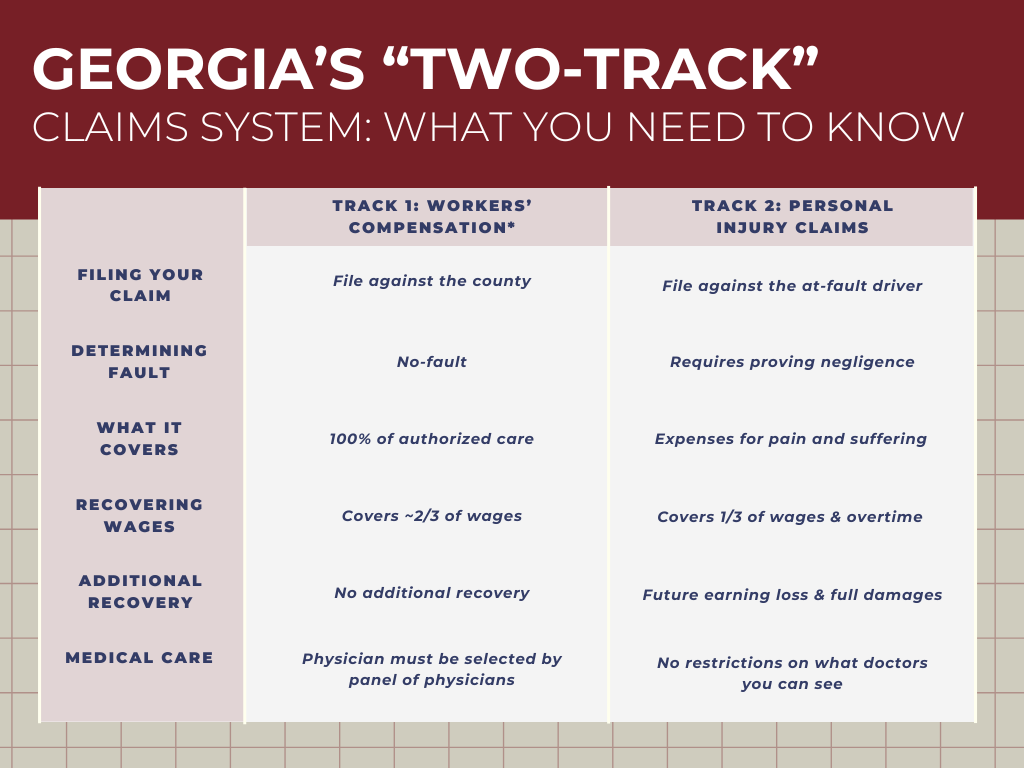
*Workers’ compensation insurers can make a subrogation lien against your personal injury settlement, but this lien is limited by the Made Whole doctrine.
What Protections Exist When The At-Fault Driver Doesn’t Have Insurance?
Georgia’s minimum liability is $25,000, which won’t cover all bills following a serious injury. A county’s uninsured/Underinsured Motorist (UM/UIM) coverage, if the county has that type of coverage, may fill the gap when the driver who hit you:
- Had no insurance,
- Had insurance but not enough, or
- Fled the scene.
If the driver flees, report it promptly to police and your insurer in writing (O.C.G.A. § 33-7-11).
Georgia is an “add-on” UM state, meaning you can stack multiple UM/UIM policies. Subrogation liens from workers’ comp can’t touch the money you get from UM/UIM policies; all of that money stays with you. All of that money stays with you.
Expected Compensation for Animal Control Workers Hit by Cars
There are a lot of sources of recovery for animal control workers thanks to Georgia’s two-track system, including everything from past and future medical bills to loss of enjoyment of life. This is what else is covered:
- Lost wages
- Lost overtime and off-duty income
- Future lost earning capacity
- Pain and suffering, anxiety, and PTSD
- Loss of consortium for your spouse
- Punitive damages, if the driver was DUI or extremely reckless (O.C.G.A. § 51-12-5.1)
Georgia Laws that Protect Animal Control Workers
Two powerful laws will help your case.
The Move Over Law (O.C.G.A. § 40-6-16)
Drivers approaching an idling or parked vehicle with flashing lights must move over one lane if safe or slow below the limit and be prepared to stop.
This law protects emergency, utility, sanitation, and similar government vehicles with flashing light bars activated.
A violation is negligence per se, meaning you don’t need to prove the driver was negligent; instead, you prove how badly you were hurt to determine proper compensation. Instead, the case shifts to proving how badly you were hurt to determine proper compensation.
Other Georgia Laws That Help You
- Pedestrians must be given due care (O.C.G.A. § 40-6-93)
- The Hands-Free Law (O.C.G.A. § 40-6-241)
- Following too closely isn’t allowed (O.C.G.A. § 40-6-49).
- Ordinary care must be taken by all Georgia drivers (O.C.G.A. § 51-1-2).
If these laws are cited in a police report, your claim will be stronger.
Do You Need a Car Accident Lawyer After Being Hit While Working Animal Control?
If you were injured in a car accident, retaining a car accident lawyer is often a wise decision. If you work for the county as an animal control officer, the at-fault driver’s insurance company may assume that workers’ compensation fully covered your injuries, which can lead them to undervalue or deny compensation for your pain and suffering and other damages. By hiring a car accident lawyer, you may increase your chances of recovering the full amount you are truly owed.
Real-World Example: A Hypothetical Example
Maria, a Cobb County animal control officer, is dispatched to a stray dog on a four-lane road in Marietta. She parks her marked truck on the shoulder, amber light bar flashing, and steps out with her catch pole. A driver scrolling on their phone drifts onto the shoulder at 50 mph and slams into her.
EMS transports Maria to Kennestone, where she’s diagnosed with a broken pelvis, two fractured ribs, a concussion, and a torn rotator cuff, requiring surgery, months of physical therapy, and a year off the job.
To receive workers’ comp (track 1), Maria reports the injury in writing the next day and selects an orthopedic surgeon from the county panel. Comp pays 100% of authorized medical bills and ~2/3 of her weekly wage.
To make additional personal injury claims (track 2), the crash report cites the driver under the Hands-Free (O.C.G.A. § 40-6-241) and Move Over (O.C.G.A. § 40-6-16) laws, indicating the at-fault driver is already found negligent.
Because the driver carries only $25,000 in liability, Maria’s lawyer recovers from multiple policies to help her recover more money:
- $25,000 — driver’s liability
- $5,000 — county vehicle MedPay
- $500,000 — county fleet UM/UIM
Her worker’s compensation insurer claims a $90,000 lien against her recovery. However, Maria’s damages exceed the dollar value of the settlement she received. Her lawyer argues that she was “not made whole” and the worker’s compensation carrier is not entitled to be reimbursed at all unless the carrier can successfully prove that Maria was, in fact, made whole. O.C.G.A. § 34-9-11.1(b)). In most cases like this, 100% of the claimed lien amount remains with Maria.
This helps Maria keep her worker’s comp medical care, replaces most of her income, and she recovers a substantial settlement on top of paying for her medical expenses.
Yes. You’re treated as “occupying” the county vehicle when working closely with it, including stepping out to handle an animal (O.C.G.A. § 33-7-11). Their UM/UIM and MedPay will also apply to your case.
No, it helps. Failing to see clearly visible lights violates the Move Over Law and the duty of ordinary care expected of Georgia drivers. By claiming they didn’t see your lights, they’re admitting to being inattentive.
Yes, because hit-and-run drivers are treated as “uninsured” (O.C.G.A. § 33-7-11). You can tap into UM coverage on the county vehicle, if the county has that coverage.
This is unlikely to happen – even though it can be possible. The workers compensation insurance carrier must prove you were “fully and completely compensated” for all of your settlement to be taken. In serious roadside-strike cases, that bar is rarely met (O.C.G.A. § 34-9-11.1(b)). Any money you get from UM/UIM is generally off-limits to the lien.
Myth busting for Animal Control Officer Injury Claims in Georgia
Myth 1: You can only recover through workers’ comp because you were on the clock.
Fact: You can pursue both comp and a third-party personal injury claim against the at-fault driver (O.C.G.A. § 34-9-11.1).
Myth 2: By standing on the road or shoulder, you cannot make a claim.
Fact: Georgia law gives animal control officers the right to be on the road and roadside. Drivers must proceed with caution and move over or slow down for your flashing lights (O.C.G.A. § 40-6-93, § 40-6-16).
Myth 3: You can’t recover when the driver flees the scene or is uninsured.
Fact: Georgia’s UM/UIM statute may, in some cases, help you recover money (O.C.G.A. § 33-7-11).
Myth 4: To get a personal injury recovery, you have to sue your county employer.
Fact: An injured worker typically cannot sue his or her employer due to Georgia’s worker’s compensation bar. However, workers’ comp is a remedy to help cover your costs. You may also have a personal injury claim against the at-fault driver.


